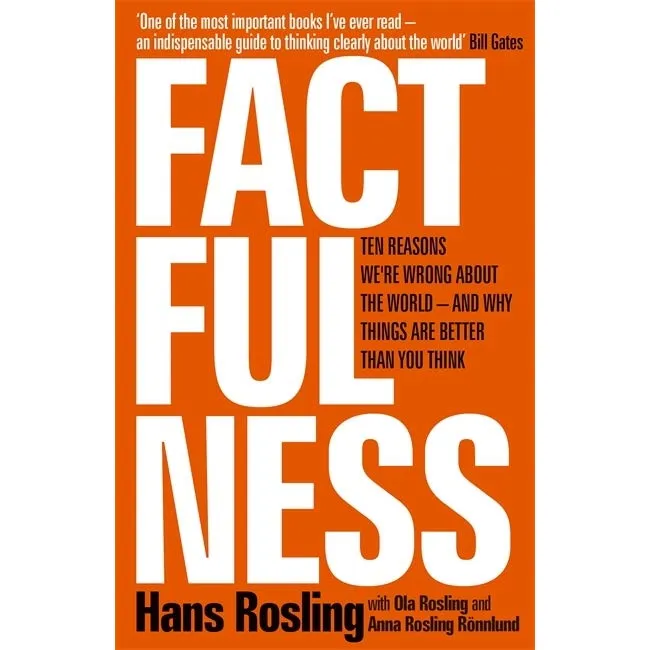
Factfulness is a refreshing counterbalance to the stream of negativity that’s inevitably coming our way at the moment. The book explores the ‘ten reasons we’re wrong about the world – and why things are better than you think’.
For anyone in or considering a global role in marketing, sales or strategy, this book will challenge your assumptions. And for anyone else that would welcome some optimism based on evidence, not wishful thinking, this would also make a great read.
Hans Rosling died in 2017, but after receiving a terminal prognosis he spent the last year of his life writing the book. In the decades beforehe was on a mission to sort fact from fiction in trend analysis, and had held roles with the World Health Organisation, UNICEF and also founded the Gapminder Foundation.
Factfulness is structured around what Rosling describes as ten human ‘instincts’ that tend to obscure the facts. But it starts with a multiple choice quiz which the author has run with many different audiences globally.
The questions test how much we really know about the state of the world. The results show that almost all audiences – including experts who you’d expect to be highly informed on such matters – believe that things are worse than they are. A monkey selecting answers at random scores a better average than most.
The book debunks – using data – the myth that the world is divided into developing and developed countries. Instead Rosling proposes a more realistic four-level framework to define and represent global development. Importantly this recognises that a single country’s population may be split across perhaps 2 or even 3 levels. We think of the world as polarised into rich and poor. But using data, Rosling shows that the bulk of people are in fact in the middle (levels 2 & 3).
One of the ten angles that Gosling explores is what he calls the ‘negativity instinct’. The author presents incredible data showing on average, what proportion of people believe the world is getting worse. The stats are incredible – in the most optimistic country more than half think the world is getting worse, rising to about 80% in the most pessimistic.
To contrast this perception with reality, the author includes 32 charts which document incredible progress in recent decades – from global literacy, to child mortality, to mobile phone coverage, to fresh water availability. That is not to claim ‘everything is perfect’ – but to recognise how far we have come.
I’d recommend this book without reservation. It will cheer up most readers and those who are in global roles will also benefit from the gentle challenges that Rosling makes to our surprisingly subjective world view.