| In the next 12-18 months many marketing and commercial leaders will be knocked off balance by a raft of cost increases. They’ll be forced to increase prices and there’ll be vigorous push-back from buyers who are themselves serving over-stretched consumers. Businesses should prepare now by eliminating the cost of anything non-value-adding, maximizing cash flows, and locking-in customers with strong relationships and contracts. To understand the logic behind this forecast, we must understand a concept at the heart of most economies, specifically ‘credit creation’. It’ll take a few paragraphs, but it will help you to cut through the upcoming noise and make a plan. Slow to catch on I’m embarrassed that I made it several decades, and held a few senior roles in organizations, without understanding enough about how money works. The only slight consolation is that – because the workings of currency are so opaque – many others are also in the same boat. Prior to 1971, the value of the US dollar was technically exchangeable for gold, a peculiar yellow metal created before planet earth, that has been recognised as money on planet earth for 5,000+ years. Other currencies were pegged to the dollar, so they were, by association, also backed by gold. In August 1971, the US temporarily came off this “gold standard” and the dollar could no longer be exchanged for gold. US president Nixon blamed gold speculators for making the suspension necessary and the public carried on using paper dollars. As often typical with temporary government controls, this one’s been tenacious. 54 years later and the suspension of the gold standard remains in place. Being ‘top dog’ currency, the dollar’s decoupling from gold precipitated major moves in other currencies – a few bounded up, but most of the pack weakened. Because gold is rare and difficult to mine, its supply only increases by about 2% a year. And what regular punters didn’t release at the time – or since – is that because the supply of gold grows at a snail’s pace, the gold standard meant the supply of money also grew slowly. It turns out that decoupling currency from gold was a politician’s wet dream. It meant the only limit to creating new money (to fund lots of exciting governmental things) was doing it slowly enough (debasement) that people didn’t cotton on and lose faith in the currency. It is probably coincidence that inflation targets for western economies are set around the unassuming, even uninteresting, level of 2%. So, what is inflation and where does it come from? Originally the term meant “inflation of the money supply”. In other words, how much new money is being created (which is now helpfully unconstrained by the pesky gold supply). When you create new currency, and the increased supply of notes chases the same amount of goods and services, prices naturally increase to absorb the new currency. An exception is when new currency is invested in expanding the productive capacity of businesses – to make new things, better things, or operate more-efficiently – then this tends not to be inflationary. Government does its best to present other explanations for why prices are increasing. Some more credible than others. Each country produces a measure of consumer inflation, the definition of which frequently changes, but rarely reflect a consumer’s lived experience of prices. During Covid, governments & central banks in several major economies created currency like it was going out of fashion. They distributed it to consumers through furlough and other ‘support’ schemes. Some went into household savings, but most of the new currency was spent on products and services and, you’ll recall, inflation hit double digits a few months later and property prices accelerated. This increase in currency happened at the same time as supply chain were frozen by lockdowns – so it could be argued that the increased money supply was chasing fewer products. In the last five years the US broad money supply has increased by about +49%. That’s a compound growth rate averaging >8% every year. You could argue this figure is closer to the average American’s experience of inflation since 2020. The kicker is that when currency is created, it represents both a credit and a debt. For Covid alone, the additional debt created in the UK was about £1/3 trillion (c. £350,000,000,000). This is additional debt that’s nationalized and now costs you and me about 4% a year in interest to service. OK, so who’s creating the extra currency? Most people naturally assume the government or its central bank are the only ones that can create credit in the form of currency. But this is not true. In a 2014 paper, the Bank of England acknowledged that 97% of “broad money” was created by commercial banks. Banking is metaphorically and literally a “license to print money”. When you scrape enough together for a house deposit, but you need to borrow say £200,000, of course you apply for a mortgage. The bank sees that you are a highly successful marketer, with a stable income, buying a property that is likely to grow in value* – so it grants the loan. *they can be pretty confident about this because they are the ones creating new currency which ultimately pumps up asset prices I naively believed that the loan came from the deposits of other bank customers holding savings accounts. But that is, for most part, untrue. It seems I was in good company though. In their models, most economists regard banks as neutral intermediaries, not creators of currency. The bank issues the loan and in doing so creates new currency. It essentially creates the currency for free (for free, people), then charges you 4% interest for each of the following 25 years. If you default, it can confiscate your house as collateral. When faced with the choice of creating currency for consumers who want to buy a house or car (low risk, profitable) or investing in a business (high risk and requires lots of work to understand the business case), the bank prefers to do the rational thing and create currency for the consumer. This is why unlisted businesses can struggle to finance expansion at the same time as consumers are encouraged to secure Deliveroo deliveries on a buy-now-pay-later basis. One of the most successful cons of our time – and an animated conversation topic at dinner tables – is that of ever-increasing house prices. Homeowners feel good when their house price increases, it encourages them to borrow and spend more. Hell, high prices even provide pots of “unearned wealth” for government to tax more. But what if house values aren’t increasing – but instead currency is losing its value? It sounds so counter-intuitive and at odds with what we learned at school. But house prices, measured in gold, have been flat for decades. Measured in currency they’ve risen faster than wages – which is why your kids may not be able to afford one. 
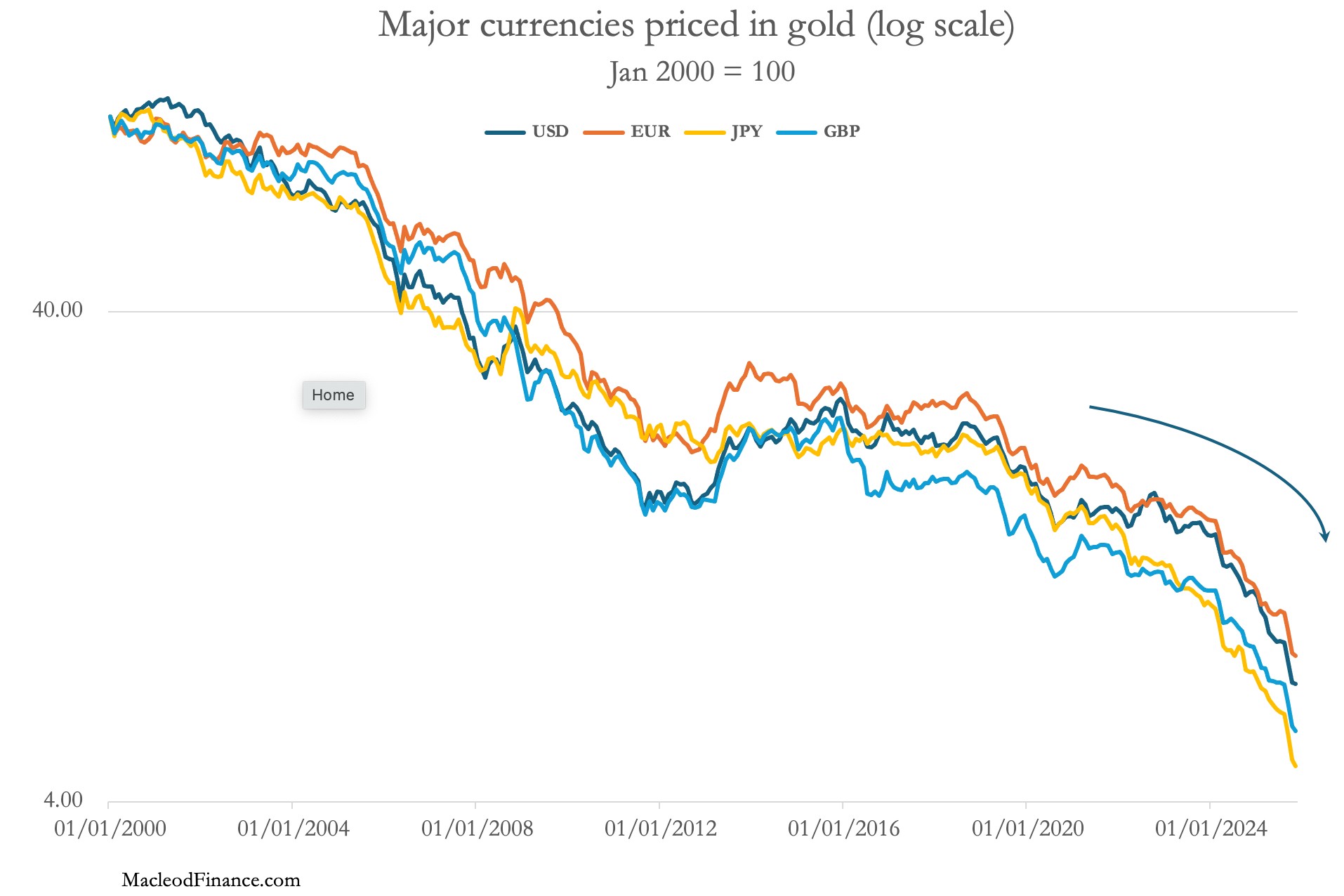
The debasement of major currencies since 2020.
Credit: MacleodFinance.com
One of the lesser-known drivers of China’s unprecedented economic success was the establishment, mostly in the 1980’s and 1990’s, of many thousands of specialized banks and local cooperatives (at one point numbering about 40,000). They were decentralized and tasked with understanding individual businesses, and making credit available to expand productive capacity and innovation. Compare that to the UK, which is home to four very large banking groups pushing mortgages and car finance to consumers, whilst offering homogeneous service to businesses and enforcing regulations that treat every SME as a terror suspect. So far, so theoretical. How does this link to the game of marketing in 2026-7? Many governments have – for decades – made spending promises to voters that far exceed tax revenues. The difference is added to national debt piles. National debts are now so huge that the interest costs alone are among the heaviest expenditure lines on the country’s P&L. In fact, national debts are now so gargantuan, they are essentially unrepayable. “Hard default” is an unpalatable option – after all, who would ever want to lend to you again if you confiscated their money? The lesson would be swift; they’d pick up their ball and play elsewhere. This may be why China is gaining new friends. Instead of ‘hard default’ governments will create currency at an accelerated pace. This is so they can continue to afford unaffordable commitments and devalue national debt in real (inflation-adjusted) terms. Even at a time when consumer inflation (even measured by dubious CPI/RPI measures) is running at 2+ times their own target, central banks are talking about the importance of “stability” and “liquidity” (code for money printing). They don’t talk much about bringing inflation down. With money printing set to go into hyperdrive, if the extra currency lands anywhere other than in business productivity, it will result in higher commodity prices that will feed through to your cost of goods and exert upward pressure on consumer prices. Now is the time to plan bigly (as a certain big spender might say). When inflation bites, smart marketing leaders are those who ruthlessly strip out non-value-adding activity. That doesn’t mean cutting muscle, but it does mean cutting out any junk that bloats budgets without creating any value. Start by mapping your end-to-end marketing processes and highlighting every step that adds neither customer value nor commercial insight. Duplicate reporting, over-engineered content rounds, unnecessary creative iterations and non-value-adding agency activity should be first to go. Redirect productive energy into the small number of activities that demonstrably drive demand. At the same time, brands with strong equity are less elastic under price pressure. Marketers can proactively reduce price sensitivity by tightening the brand’s distinctive assets, refreshing memory structures through consistent reach, and demonstrating category leadership. Make sure your CEO and CFO understand the relationships between strong brand equity and price elasticity otherwise, by default, marketing budgets will look like the easiest thing to cut when the inflationary shit hits the fan. Understand and reinforce distinctive brand assets so they’re unmistakably yours, invest in top-of-funnel to maintain mental availability, and emphasise proof points that reinforce the superiority of your product or brand experience. If you truly understand which specific product or service attributes your consumers really value, you could cost-reduce non-essential elements via reformulation or reconfiguration. If you don’t have that knowledge, put research in place now to find out. These steps build a buffer so that when price rises come, customers attribute them to market realities rather than your brand being opportunistic. Finally, inflation is easier to weather when cash flow is healthy, and customer relationships are “stickier”. Marketers can support both by designing propositions that deepen commitment. Think about subscription models, loyalty mechanics that reward continuity, and commercial partnerships that lock in multi-period contracts with key customers. Review payment terms, accelerate billing to customers where possible, and work with finance to front-load cash-generative activities such as pre-sales or early-commitment programmes. Don’t get caught out I’ve belatedly concluded that the currency system relies on people not understanding it. Opacity is a feature, not a bug. Unfortunately, that means that inflation will catch many businesses off-guard and underprepared in 2026-7. You and I alone cannot make the financial system more transparent or fair, but we can do our bit to prepare for the inevitable fallouts. In an inflationary environment, the brands that win aren’t just cutting costs — they’re fortifying the engines of demand and building more predictable cash into the system. PS – if you have kids and want them to understand where most inflation really comes from, this is a fun & educational watch – https://www.angel.com/watch/tuttle-twins/episode/5daf8a13-4532-4fbf-a89f-e37d544c0ec0 Note – the focus of this article is predominantly Western (e.g. G7) economies, the principles still apply to many other countries, but the West has particularly challenging circumstances and vulnerability to high inflation. |