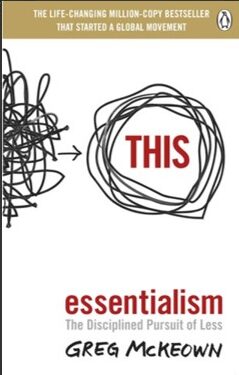
The book “Essentialism: The Disciplined Pursuit of Less” is at its core, a manifesto for doing less, but better.
I’d recommend this book to anyone. Indeed, it was one of the inspirations for my approach to helping clients with their challenges.
Greg McKeown’s central argument is simple but uncomfortable: most people and organisations are trapped in the “undisciplined pursuit of more,” spreading effort thinly across too many priorities and achieving little of consequence.
Instead, he proposes a disciplined approach:
- Identify the vital few areas where you can make your highest contribution
- Systematically eliminate the trivial many
- Protect time and energy to execute what truly matters
The relevance to the law of triviality (bike shedding) is clear. Essentialism explains why this happens and, more importantly, how to counteract it.
McKeown’s key discipline is the ability to say “no” to good opportunities in order to preserve focus on the few that matter most. In a business context, that translates to:
- fewer initiatives
- fewer debates
- fewer decisions
But better ones.
The thesis is that bike shedding represents a prioritisation failure. When everything is on the table, trivial issues inevitably consume disproportionate attention.
Essentialism proposes an even more brutal mantra:
If it isn’t clearly essential, it shouldn’t be discussed at all.
For senior teams, this is less about productivity and more about strategic clarity. The discipline is not in working harder or faster; but on deciding, early and explicitly, what doesn’t deserve airtime.
That, in practice, is how you escape the gravitational pull of the trivial many … and focus on the meaningful few.