
Senior marketers, comms professionals or salespeople have often risen through the ranks because of their functional experience. In other words, because they know the answers.
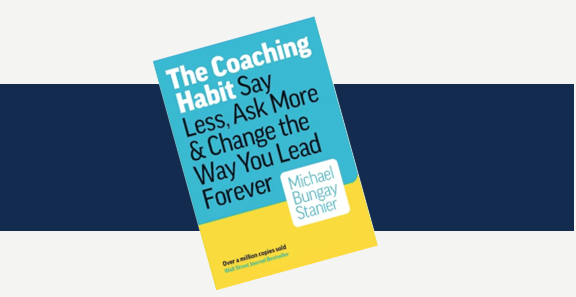
But as Michael Bungay Stanier (MBS) highlights in The Coaching Habit this can lead to the “advice monster” habit. Where managers are too ready to offer advice to others – and unwittingly accumulate obligations.
How do we show up as a leader?
Is it as someone who’s quick to advise – or someone who helps others to reach their own answers? Is it by being all over the detail themselves – or having the confidence their team will be on it? Is it by being very busy (even if that’s “good busy”) – or deliberately creating space for quality thinking?
Through assumption and over-use, the word ‘coaching’ (like ‘strategy’) has lost meaning.
Coaching isn’t therapy speak; but a commercial productivity tool. It shouldn’t be a grand but useless ‘set-piece’ ritual – like annual appraisals. Instead, coaching is a leadership habit that should be practised daily, and in so doing, will just become part of the way things get done.
MBS (not a Crown Prince) is a Canadian author whose work is focused on moving people from advice-driven to curiosity-driven management. The Coaching Habit remains one of the best-selling coaching books of the past decade and the core premise is simple: do less advising and more asking.
In the contemporary organisation, a lot of leadership happens outside of the boss/employee relationship. And coaching techniques can be used by anyone, even if they don’t have a fancy title or a team of their own.
For example, I found The Coaching Habit while preparing a workshop for a global marcomms team.
The team’s success relies on getting what they need (customer and competitor insights, commercial context, comms briefs) from other teams and senior stakeholders. As any group whose work relies on others for quality inputs will attest, the risk is always “crap in – crap out”.
One of the things we’ll explore during the workshop is how to apply coaching questions, in a natural way, to have better interactions with commercial colleagues. The end goal is to produce marcomms work that has commercial impact. One powerful way to get there is by having more curious conversations with internal clients.
Inputs are never intentionally bad – they come from people who are navigating ambiguity: tough markets, evolving financial goals and customer/competitor dynamics. To simply lob a brief back over the fence is unhelpful. Smart use of coaching helps internal clients get clearer about what they need.
Simple but effective
In his book, MBS presents a simple formula for holding coaching conversations. I instinctively dislike the idea of standardising human interactions, but what the book offers is a toolkit of incisive questions with a suggested flow.
Rather than ‘cookie cutter’ conversations, his questions help you get to the meaningful bits quicker and in a manner that doesn’t mean you take on responsibility for other people’s work.
Here are The Coaching Habit’s seven questions and my interpretation of why they’re useful: –
- The Kickstart Question: “What’s on your mind?” – This cuts through small talk and gets straight to what actually matters.
- The AWE Question: “And what else?” – Recognises that the best answer is rarely the first one. This question helps get you to the real one.
- The Focus Question: “What’s the real challenge here for you?” – Helps cut through the clutter and avoids solving the wrong problem.
- The Foundation Question: “What do you want?” – This forces clarity before either person wastes time on the wrong outcome.
- The Lazy Question: “How can I help?” – This kills off the ritual where we dance around for ages trying to work out what is being requested.
- The Strategic Question: “If you’re saying yes to this, what are you saying no to?” – This question makes the trade-off visible and helps avoid the to do list ‘pile-on’.
- The Learning Question: “What was most useful for you?” – This helps identify something that actually sticks and you get feedback on the conversation.
Practical application
This book succeeds where many fail, because it is lean in size and extremely practical.
Here are a few suggestions for things you can do today to have an impact.
- Rather than do all seven, just start with the “AWE” question – ask “and what else”. This may be the lowest effort, highest impact prompt. And it could help you get closer to what matters more quickly.
- Don’t regard leadership as a purely “up–down” activity. The coaching habits work just as well in peer-to-peer work conversations, chats with your kids or other family members.
- Don’t see coaching as a bolt-on activity or some grand intervention. Experiment with doing a little bit whenever you can.
- Use coaching habits as a means of becoming known as someone who elevates others. Leadership means doing less yourself and enabling others more (whether or not they report to you).
- In updates with your team – as long as it’s appropriate – deliberately avoid taking direct ownership of the other person’s problem. Instead, use the seven questions to help them to unlock the answer, without you dropping into the role of rescuer (by offering “the answer”).
How you show up in these small moments is what you end up known for in your business. Start with just one coaching question – or one colleague – and see what changes.