
Last week, the WalMart-owned supermarket chain Asda announced that it was reintroducing the ‘pocket tap’ into its advertising. Most Brits over 25 will remember seeing Asda ads featuring a celebrity or actor tapping their pocket twice to emphasis the chain’s commitment to low prices.
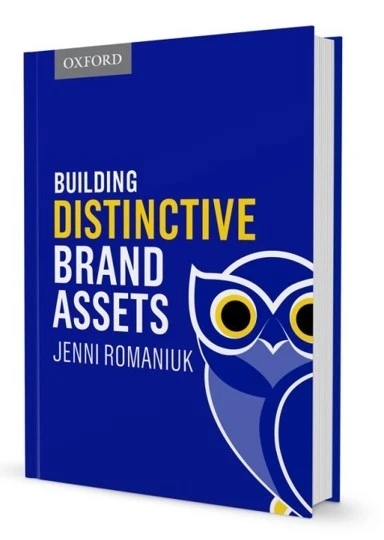
The importance of developing distinctive brand assets (and how to do it) is something covered in a book by Jenni Romaniuk called ‘ Building Distinctive Brand Assets’ I read and reviewed this a couple of years ago when it was first published. The lessons in that book, summarised below, explain why Asda is probably right to revive the ‘pocket tap’ (and why it was wrong to ditch it).
‘Building Distinctive Brand Assets’ is written by Jenni Romaniuk from the Ehrenberg Bass Institute (the same business school that brought us ‘How Brands Grow’ – which has influenced how marketing is practiced across many businesses). In fact, the new book takes one of the seven ‘rules’ developed by Byron Sharp in How Brands Grow and develops how assets can be managed both strategically and operationally.
Brand assets provide sensory and semantic cues – examples include logo, tagline, colour, sound, shape, etc. Sharp proposed that marketers should create easy-to-remember assets that will over time (with constant & consistent use) create memory structures and keep the brand top-of-mind for buyers.
Brand assets have three main functions:
- Ownership – denotes that a product or service offer is from a certain provider and comes with a certain promise about what it will deliver for the customer. If we see a new confection from Cadbury’s, purple elements on packaging are likely to offer reassurance about taste/quality.
- Anchor – helps anchor knowledge into the customer’s mind. For example, you’ll recognise McDonald’s and the golden arches as brand assets already, but advertising McCafe associates coffee with the original memories; meaning that the McDonald’s brand could be recalled when you’re craving a caffeine hit.
- Bridge – assets act a bridge between different marketing activities. If the different components of a marketing campaign contain one or more recognizable brand assets, as a customer I join them together and then experience the impact of a full campaign (not just individual elements).

The two drivers of brand asset strength
Romaniuk says that the strength of brand assets is driven by two factors –
- Uniqueness – the degree to which the assets are unique in your category (not universally unique, but compared with competitors that could be considered in the same sort of purchase decisions).
- Fame – the extent to which assets are recognised and linked to your brand by people, fame often takes time and investment to develop – and needs to be maintained.
Too often branding decisions are based on intuition; rarely afforded the same level of research that other decisions are. Romaniuk shows how it is possible to research the strength of an asset as a means of deciding which assets have greater value. Using this insight, it is possible for marketers to take an objective view about the strength of their portfolio of assets … and probably a reality-check about how many are ‘invest-able’ and how many are distractions.
The book is definitely worth a read, especially as it includes evidence-based learnings about specific aspects of branding (for example, there are sections on aspects as diverse as brand architecture, sound as a branding device and celebrity endorsement). In the meantime, I’ve summarised my five key take outs. These themes struck me as having relevance to anyone involved with branding –
- Don’t support too many assets. The author shows how fame & uniqueness can be plotted onto a matrix to help marketers determine which assets are strong, which have potential, and those which should be ‘reviewed’ or ditched. The insight is that we often over estimate the strength of assets and just how many we can realistically introduce and support. Small numbers of strong brand assets drive success.
- Build toolkit for touchpoints. In today’s media landscape, assets have to work across a multitude of touchpoints (from packaging, in store, within brochures, on mobile … the list is nearly endless). While assets need to clearly belong to the same ‘family’ Romaniuk says marketers need a toolkit from which to select the most appropriate manifestation for the medium.
- Ignore “over branding” myths. Many of us have had arguments with agencies about the appropriate level of branding on an ad. The author shows evidence that contrary to the guidance many marketers receive, high levels of branding or branding early in an advert do not reduce the viewer’s enjoyment. In fact, in certain environments such as YouTube pre-rolls, early branding mitigates against people skipping after the few seconds, whilst visual branding throughout is important if videos are viewed in social media feeds (such as Facebook) with no sound.
- Avoid false diagnosis. This one definitely speaks to the “3Rs” marketing stigma! Romaniuk highlights that brand redesigns or “refreshes” are rarely the answer to brand performance issues. For example, she counsels against restaging even if consumers describe the brand as “old fashioned” in qual groups. The brand assets themselves are rarely a driver of weakening brand image or sales decline.
- Be consistent, stop fiddling. Sometimes the hardest thing to do is nothing. As marketers we often have an ‘action bias’ and changing assets is sometimes the result of a need to be seen to be “doing something”. However, strong brands are developed as a result of creating and strengthening neural pathways in the customer’s brain – which means consistent and frequent use is the basis for establishing familiarity & associations (not frequent revisions).
How strong are your brand assets? How do you know? Are you spreading resources too thinly across different assets? Does your team act to build assets consistently over time to build memory structures in the minds of your customers?