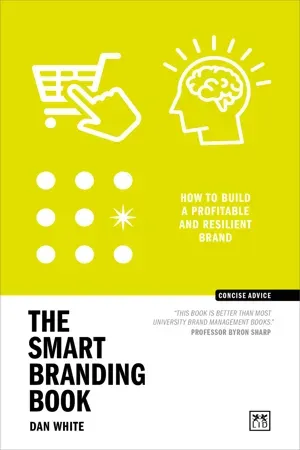
| Advertising guru Dave Trott once blogged: “People are impressed by complicated things. But actually, complication is the enemy. If you can’t understand it you can’t remember it. If you can’t remember it you can’t act on it. If you can’t act on it, it’s useless” You won’t find a quote more relevant to “The Smart Branding Book” by Dan White, released a few months ago. Academic publishers get a kick out of making the reader work hard to discover the principles of something, whereas business books often contain one or two good ideas plus 300 pages of padding to justify the price. This book is neither of those things. It’s a super concise and accessible summary of evidence-based principles of brand marketing. Who’s it for? - CEOs who want to be able to ask the right questions of their marketing team
- Marketing directors who want to be able to explain brand concepts to their boss in a concise way
- Marketers who don’t want to trawl through thick text books for hours finding the most useful nuggets
- Sales or R&D people moving into marketing that want a quick but serious primer on brands and brand development
What are some of the best bits? The Value of branding AKA negotiating with the CEO for more budget, or at least not to have the budget slashed. Making the case for investment in brand building is a tough gig – lobbing cash at a price promotion normally generates a better short-term uplift. In the way that sugary drinks offer a short-term boost (but make you fat and rot your teeth over the long term). Conversely, brand building is a long-term investment, but one that protects and enhances price. The ability to command a higher price is – as we know – the most effective lever a business has to increase profit. Mental market share. A reminder that categories should, preferably, be defined by usage contexts (or to use Byron Sharp lingo, category entry points). If it’s your brand that comes to mind for a particular usage context, you’ll be considered and have the best chance of securing the sale. But there are often different usage contexts and myriad advertising messages competing for a share of the consumer’s mind. So, the author recommends focusing communications in order to “own” one specific usage context before expanding to others. Purpose-led branding Despite being all the rage in marketing circles, purpose advertising campaigns are no more effective than any other type of communication (Field, 2021). That’s not to say “don’t do them” but instead, be deliberate about how purpose is “done”. Purpose works best when a cause is a company (not just brand) priority, and when it is clearly relevant to what the company does. I like this Venn diagram model which can help business to be more considered – it suggests when a purpose is most likely to have a positive brand building effect – and when it is less likely to work. How brands can die The author highlights 4 reasons why brands decline. Most brands, he says, fade away as they become irrelevant in an evolving category. Eventually weak brands are “put out of their misery” by either a distributor or brand owner. When I worked at Mars Confectionery many moons ago, it was drilled into us that our job was to leave our brand in a stronger position than we found it. The needs of marketers’ egos were infinitely subordinate to brand development. In an impulsively bought category, we needed as many Mars products as possible in the top 10 sellers list. That would guarantee distribution in even the smallest of kiosks and vending machines – and distribution levels correlate very strongly with the number of buyers a brand has. Not rocket science, but in hindsight, I realise just how powerful this mantra was as a part of our culture. This brilliant little book punches above its weight. Even for seasoned branding experts, there are times when it’s helpful to go back to essential principles and recall what matters and why. This book helps do just that. |